
Emergency Tree Service: What to Do When a Tree Falls on Your Property in NJ
🚨 Tree emergency in NJ right now? Don’t wait — tap Call below for immediate 24/7 response and a free on-site estimate. Wayne’s Tree Service covers Somerset, Hunterdon, Middlesex, and Union counties, and we’ve been the trusted emergency crew for Central NJ homeowners since 1993.
If you have a moment before you call: get people out first, keep everyone well clear of any wires (assume they’re live), and dial 911 if utilities are involved or anyone’s hurt. Then contact your power and gas companies, take thorough photos, and loop in your homeowner’s insurance. The full step-by-step guide is below — but if the tree is on your house, car, or blocking access, call us first and read this later.
Call (732) 805-0609 Request a Free Quote 24/7 emergency line · Same-day response · Licensed & insured since 1993 🚨 Tree Down on Your NJ Property? 📞 (732) 805-0609 24/7 Emergency Response · Licensed & Insured Since 1993Key Takeaways
- If a tree hits your house, car, or yard in NJ, safety comes first. Evacuate if the structure might be damaged and treat every wire like it’s energized.
- In New Jersey, the owner of the property where the tree lands is usually the one paying for cleanup, unless you can show the tree owner ignored a known hazard.
- Most NJ homeowner insurance tree coverage only helps with fallen tree removal when a covered structure is damaged, and even then you’re often capped at around $500–$1,000 per tree with an overall limit per event.
- If a tree only lands in the yard and doesn’t hit a home, garage, fence, or similar covered structure, removal is often not covered and becomes an out-of-pocket project.
- Call 911 if any power lines are down or trees are blocking public roads. Then contact your utility: JCP&L or PSE&G for electric, plus your gas or water provider if those systems might be damaged.
- Before a single branch is cut, document everything. Take wide and close-up photos, walkthrough videos, note report numbers from utilities and first responders, and keep any written Licensed Tree Care Operator findings.
- Emergency tree removal in NJ typically runs $500–$3,500+ depending on tree size, access, complexity, crane needs, and how crazy the storm conditions are.
- You can avoid a lot of emergencies by having a Licensed Tree Care Operator inspect trees annually, removing deadwood, and taking out obvious hazard trees before the next big NJ storm rolls through.
What Is “Emergency Tree Service” in NJ?
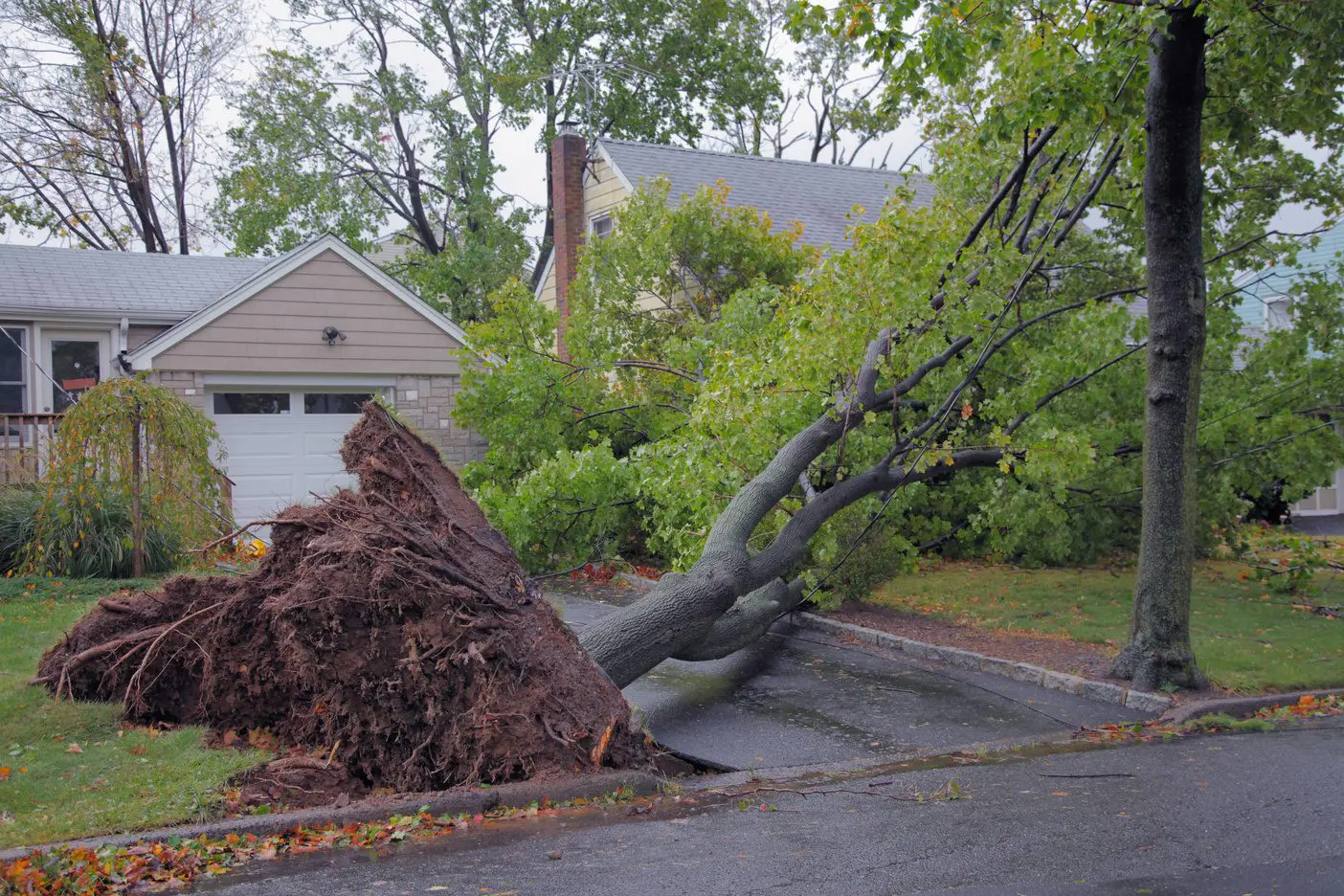
What is emergency tree service? In New Jersey, emergency tree service means urgent, often same-day or middle-of-the-night response to a tree that has fallen or is threatening to fall on a house, vehicle, power line, or public way. You see this a lot after nor’easters, thunderstorm microbursts, and hurricane remnants that tear through neighborhoods.
Real emergency tree work usually involves:
- Making the scene safe by stabilizing the tree, cutting it in sections, or rigging it so it stops shifting
- Coordinating with utilities any time live wires, meters, or poles are involved
- Carefully removing the tree from roofs, walls, decks, or vehicles without causing more damage than the storm already did
- Initial debris clearing so contractors can tarp the roof, secure openings, and you can safely access the property
Emergency service is a different animal than routine pruning or a scheduled removal on a calm, sunny day. See our 24/7 emergency tree service page to book direct. Crews are working in high-risk situations, often at night, with compromised structures and live power nearby, which is why emergency tree removal New Jersey pricing and procedures look nothing like your average trimming job. For commercial 24/7 emergency tree removal, see our service page.
What to Do Immediately When a Tree Falls on Your NJ Property
If you’re standing there thinking, “A tree fell on my property in NJ, what do I do now?”, there’s a simple order of operations. Protect people first. Then protect utilities. Only after that do you start worrying about insurance, cleanup, and who’s paying the bill.
Start by getting everyone to a safe area, especially if the tree hit the house or garage. If there are wires involved, stay back, call 911, and let the emergency crews and utilities control that part. While you’re waiting, you can start documenting the scene from a safe distance so you’re ready for the insurance adjuster.
Step 1 — Safety & Evacuation
Your first job is simple: nobody gets hurt. You can replace shingles and siding. You can’t replace people.
Check for immediate danger:
- Look where the tree landed. Did it hit the house, roof, porch, or garage? Inside, check for sagging or bowing ceilings, sticking doors, new cracks in drywall, or walls that look slightly shifted.
- Scan for sparks, arcing, buzzing, or smoke near the point of impact, especially where it crosses wires, meters, or the service mast on the side of the house.
- Sniff for gas. A rotten-egg smell, hissing sound near the meter, or bubbling in wet soil can all mean a leak.
- Check that nobody is injured or stuck under debris. Don’t try to move big sections of tree off someone yourself. That can shift the load and make things worse.
Evacuate when in doubt:
- If the tree is on the house and you’re not 100% sure about the structure, get out immediately. Lean toward caution. Roof and wall damage can fail suddenly after the initial hit.
- Keep kids, pets, and curious neighbors away from the fallen tree and any nearby wires. People love to go “take a look” and that’s how accidents happen.
- Do not walk or stand under hanging limbs, cracked branches, or a leaning trunk. Even a small shift in the wind can bring those down.
Pick a safe spot on the opposite side of the house or at a neighbor’s place and stay there until fire, police, or a structural pro says it’s safe. Treat the area like an active jobsite. If you wouldn’t stand there while a crew’s cutting, don’t stand there now.
Step 2 — Call 911 If Lines Are Down
Any time a fallen tree and overhead utilities are in the same picture, you assume the worst. That means you assume the line is energized, even if the whole block is dark and it “looks dead.” Lines can come back live without warning once a breaker is reset upstream.
Call 911 immediately if:
- Power lines are on the ground, on the tree, draped across the yard, or attached to a damaged pole
- The tree is blocking a public road, trapping someone in a vehicle, or blocking emergency access to a home
- You see fire, arcing, smoke from the roof or wires, or smell gas near the fall zone
- A utility pole is cracked, snapped, or leaning at a new, scary angle
Tell the dispatcher your exact address, cross streets if you know them, and clearly say that a tree has fallen and there are possible utilities involved. Mention if there are injuries, people trapped, or a road blocked. Under the NJ municipal emergency management system they’ll get police, fire, and the appropriate utilities headed your way in the right order.
Step 3 — Contact Your Utility Company
Once 911 is aware of any life-safety issues, loop in your utility companies. Tree crews in NJ can’t safely start real work around live lines or damaged gas systems. We wait for the utilities to handle their side first or at least make the site safe enough to work around.
If you are in a JCP&L area (Jersey Central Power & Light):
- Use the emergency or outage number printed on your bill or listed on the JCP&L outage center site. During a storm, those lines will be busy, so expect some hold time.
- The JCP&L downed line protocol is straightforward:
- Stay a minimum of 30 feet away from any downed or low-hanging wires. More distance is even better.
- Don’t touch trees, fences, metal sheds, or puddles that might be contacting a wire. Electricity travels in ways you don’t always see.
- Give them a clear location, including cross streets, visible landmarks, and whether the tree is blocking traffic or driveway access.
- They prioritize high-risk situations first. That means live wires on roads and critical facilities before individual homes, even though they’ll eventually get to everyone.
If you are in a PSE&G area:
- Call the PSE&G emergency number shown on your bill and website. They have separate lines for electric emergencies and gas leaks.
- If the tree came down close to gas infrastructure, mention any gas odor, hissing, or freshly exposed piping or meters when you call.
Other utilities to contact if affected:
- Gas company: Call if the root ball ripped up soil around the meter, underground line, or you smell gas anywhere near the tree.
- NJ American Water or local water utility: Report if you see water bubbling from the ground, new flooding, or obvious damage to hydrants or curb boxes.
- Cable/phone/internet providers: Non-emergency, but worth reporting if lines are down across driveways or sidewalks so they can schedule repairs.
Always ask for and write down the utility report number. That little reference number helps your insurance adjuster confirm what happened and when, and it shows you did your part to handle the emergency correctly.
Step 4 — Document Everything for Insurance
Before a single limb hits the chipper, build your paper trail. NJ homeowner insurance tree coverage almost always depends on what you can prove. Once the tree’s cut up and hauled away, it’s your word against whatever the adjuster can piece together.
Document the fallen tree thoroughly:
- Take photos from several angles. Start with wide shots that show the entire scene: the tree, the structure, and the surroundings. Then grab close-ups of:
- The trunk, including the base, roots, and any obvious rot or breakage
- Damage to the roof, gutters, siding, windows, fence, deck, garage, shed, or vehicles
- Any downed or low sagging lines, poles, or utility hardware, but only from a safe distance
- Shoot a video walk-through. Narrate as you walk, pointing out where the tree hit, what rooms you’re worried about, and any leaks or cracks.
- Write down the police or fire report number if emergency services showed up. Ask the officer or firefighter on scene how to get a copy.
- Keep that utility report number from JCP&L, PSE&G, or other providers together with your claim paperwork.
- If there were prior concerns about the tree, get an Licensed Tree Care Operator assessment or copy of any past reports. That becomes very important in neighbor disputes or negligence claims.
Report the loss to your homeowner’s insurance within 24–48 hours if you can. Many NJ policies require prompt notice, and some carriers like to send an adjuster or give specific instructions before the tree is completely removed from the house or garage.
Step 5Get an Immediate Damage Estimate
You've got your photos and utility report. Now hand the mess to us. We'll walk your property, document damage for your insurer, and give you a written estimate — free, on-site, same day.
📞 Call (732) 805-0609 or request an online estimate →Who Is Responsible for a Fallen Tree in New Jersey?
“Fallen tree, who’s responsible?” is one of the first questions people ask, usually while staring at their neighbor’s oak sitting on their roof. In New Jersey, it comes down to two big things: where the tree ended up and whether anyone dropped the ball on dealing with a known hazard.
Most of the time, the property owner where the tree falls uses their own insurance for cleanup and repairs. That’s the default. You start talking about the NJ liability negligence standard when there were clear warning signs the tree was a problem and the owner ignored them. Big storms can trigger the act-of-God defense, which often pushes both parties back to their own policies.
Basic Rule: Where It Falls, It’s Your Problem
Under standard NJ storm liability rules, every homeowner is expected to insure and take care of their own property. That can feel unfair, but that’s generally how claims shake out.
- If your neighbor’s tree fell on your property in NJ, you usually file a claim with your own carrier first. Their tree, your roof, your insurer. That’s the default unless you can prove negligence on their side.
- If your tree lands on a neighbor’s home, car, or fence, their insurer usually picks up their tab in the same way, again unless there’s strong evidence you ignored a problem tree.
Healthy trees falling in a nasty nor’easter, hurricane remnant, or violent thunderstorm are often treated as accidents, not anyone’s fault. Courts and insurers see those as part of living in a wooded, storm-prone state.
When the NJ Negligence Standard Applies
Things change if someone ignored a tree that was screaming for attention. Under the NJ liability negligence standard, responsibility may shift if the tree owner knew, or should reasonably have known, the tree was unsafe.
- The tree owner may be on the hook if they knew or should have known the tree was dead, badly diseased, hollow, heavily decayed, or structurally unsound and did nothing.
- Useful evidence can include:
- Visible decay, huge dead branches, mushrooms at the base, or a serious lean toward a home or driveway
- Written warnings or evaluations from a Licensed Tree Care Operator recommending removal or major pruning
- Emails, letters, or texts where a neighbor pointed out the risk or asked them to have the tree checked
In these situations, your insurance company may pay your claim first, then use subrogation to chase reimbursement from the tree owner’s carrier if negligence looks clear. Or you might be able to recover directly, often up to the small claims limit in your NJ county. That limit changes periodically, so confirm the current number if you go that route.
Act of God Defense in NJ Storm Damage
Big weather events are a different story. When a tree fails during a severe nor’easter, tropical storm, or historic thunderstorm, the act-of-God defense commonly comes into play. That argument says the storm was so strong or unusual that even a reasonably careful tree owner couldn’t have prevented the damage.
Typical act-of-God situations:
- Nor’easter blasts that drop trees across entire neighborhoods and multiple NJ counties
- Hurricane remnant damage in NJ that comes with extreme winds or saturated ground that uproots healthy trees
- Events big enough to trigger a FEMA disaster declaration in NJ with widespread public damage and debris
In those cases, the usual result is each property owner going to their own insurance. The tree owner is not automatically responsible just because the trunk grew on their side of the property line.
Time Limits and Documentation for Liability Claims
If you think a neighbor’s negligence caused your damage, you need more than frustration. You need documentation and you need to pay attention to the clock.
- Statute of limitations for NJ storm liability claims is not endless. Property damage and personal injury claims have deadlines, often in the 2–6 year range depending on the details. A NJ attorney can give you current numbers for your specific situation.
- Most insurers follow an insurance first approach. They expect you to file on your policy first. After that, they decide whether to pursue the other party’s insurer behind the scenes.
- Fallen tree documentation is your leverage if you push for recovery:
- Date-stamped photos or videos of the tree before it fell, showing obvious decay or lean if you have them
- Copies of earlier complaints, emails, or certified letters to the neighbor or town about the same tree
- Police, code enforcement, or municipal reports where the tree was noted as a concern before it failed
If you’re not sure how strong your case is, ask your adjuster how they view it or run it by a local attorney who deals with storm damage liability in NJ. Just don’t wait until the deadlines are breathing down your neck.
Does NJ Homeowner Insurance Cover Fallen Tree Removal?
Most HO-3 homeowner policies in New Jersey offer some level of homeowner insurance tree removal coverage, but the fine print matters. Tree on the lawn with no damage usually means you’re paying. Tree on the roof or crushing the fence means your policy might help, subject to caps and deductibles.
In general, your insurer cares about two questions. Did the tree damage a covered structure or block access to your driveway? And was the cause a covered peril like wind, lightning, or the weight of ice or snow?
When Insurance Pays
NJ homeowner insurance tree coverage often kicks in under these conditions:
- The fallen tree physically damages a covered structure such as your house, attached or detached garage, shed, fence, or deck.
- The tree blocks your driveway so you can’t reasonably get a vehicle in or out. Some policies spell this out very clearly.
- The fall is tied to a covered peril. In NJ, that usually means windstorm, lightning, or the weight of ice or snow. Flooding and earth movement are usually a different story.
Common policy details I see on jobs:
- Per-tree removal limit: Often in the $500–$1,000 per tree range, with a total cap per incident like $1,000–$2,500. This is separate from what they’ll pay to fix the actual structure.
- Structure damage requirement: Many policies say they’ll only pay to remove trees that damage a covered structure or block a driveway. Trees lying in the grass often don’t qualify.
- Deductible application: Your normal deductible still applies. So if the claim is $3,000 and you’ve got a $1,000 deductible, the insurer’s portion is $2,000.
When You Pay Out of Pocket
When insurance won’t pay, you’ll arrange tree removal after storm directly with a licensed crew.
There are plenty of situations where you’re on the hook for tree removal after a storm without insurance help. They’re not fun, but they’re common.
- The tree drops in the yard only. No hit to the roof, fence, shed, or driveway. Just an ugly mess on the lawn.
- The tree only damages items not covered by your policy, like some older outbuildings, certain types of fencing, or excluded structures.
- The total bill for cleanup and minor touch-ups is close to or less than your deductible. In that case, opening a claim can be more trouble than it’s worth.
- The tree failed mainly due to an excluded cause, like long-term neglect or slow internal rot that your policy treats as a maintenance issue instead of a sudden accident.
Most policies treat trees, shrubs, and landscaping as limited coverage items, not full-blown structures. They’ll sometimes help if a tree is part of a bigger covered loss, but they rarely pay just to haul away perfectly healthy trees or untouched debris you decide to clear “to make things look nicer.”
Filing the Claim Correctly
If you want your NJ insurance tree removal claim to go smoothly, handle it like a project. Be organized and clear from the start so the adjuster doesn’t have to guess what happened.
Steps to file a claim:
- Review your policy or online account before you call:
- Confirm your deductible so you know whether the numbers make sense to claim.
- Look for the per-tree and per-incident limits for tree and debris removal.
- Check for special wording around windstorm, hurricane, or flood that might limit or change coverage.
- Notify your insurer quickly, ideally within 24–48 hours:
- Use their claims line or mobile app to open a claim record.
- Be specific: “A tree fell on my property in NJ and damaged my [roof, fence, garage, deck] during [storm type].”
- Provide the storm date, approximate time, and mention if it was a nor’easter, thunderstorm, or hurricane remnant damage in NJ.
- Provide documentation early:
- Upload or email your photos and videos showing the tree and damage from different angles.
- Share utility, police, or fire report numbers so they can verify timing and severity.
- If there’s a dispute about a neighbor’s tree, include any Licensed Tree Care Operator assessment showing disease, decay, or prior recommendations.
- Get multiple estimates for both tree work and repairs:
- Ask tree services and contractors to break the quote into: tree removal off the structure, general debris cleanup, and structural repairs.
- This breakout helps the adjuster apply coverage correctly, since not every line item is treated the same under the policy.
- Follow insurer instructions closely:
- Some carriers want an adjuster or virtual inspection before complete removal, especially if liability is in question.
- Others will approve immediate emergency work for safety, as long as you keep all photos and invoices. Ask before you start major work if you can safely wait.
Expert tip competitors often miss: Ask your adjuster whether they cover tree removal off the structure separately from full site cleanup. In a lot of NJ claims I’ve seen, they’ll pay the higher-risk work needed to safely get the tree off the house or garage, while limbing, chipping, and yard cleaning become your cost.
✅ We work directly with your insurance adjusterWayne's Tree Service has handled hundreds of NJ homeowner-insurance claims since 1993. We provide everything your adjuster needs so your claim moves fast:
- Written Licensed Tree Care Operator damage assessment
- Itemized removal & cleanup estimate
- Photo documentation & job invoice on carrier letterhead-friendly format
NJ Utility Emergency Contacts for Downed Trees
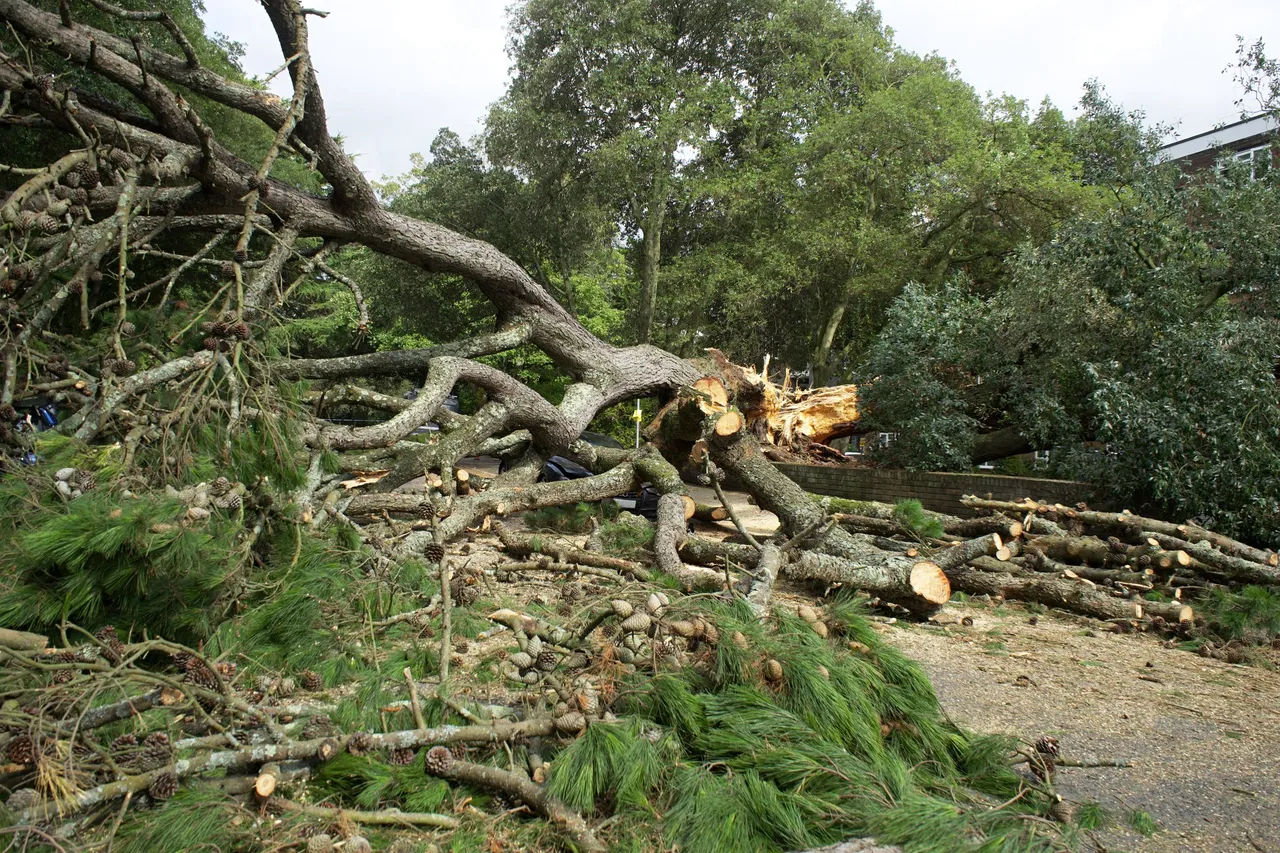
Any time trees and utilities mix, homeowners have to step back and let the power company call the shots. Tree crews can’t start cutting a big maple that’s tangled with a 13 kV line until the line is de-energized or cleared by utility crews.
In New Jersey, especially in Central NJ counties like Somerset, the fastest way to get that ball rolling is to call 911 for immediate hazards, then contact your electric, gas, and water companies. During big storm events, your local Office of Emergency Management, such as Somerset County OEM, may coordinate the bigger picture.
| Utility / Agency | When to Call | Key Notes |
|---|---|---|
| JCP&L (Jersey Central Power & Light) | Downed or sparking power lines, tree on primary lines or transformers, damaged or leaning poles. | Follow JCP&L downed line protocol: stay at least 30 feet away, keep others back, and report exact location, cross streets, and any blocked roads or driveways. |
| PSE&G | Any downed electric lines, suspected gas leaks near uprooted trees, or visible damage to PSE&G equipment. | Use the PSE&G emergency numbers on your bill or their website. If you smell gas, evacuate and call 911 too. Don’t try to shut off gas yourself if you’re unsure. |
| NJ American Water / Local Water Utility | Tree roots or uprooting that lift water mains, service lines, hydrants, or cause unexplained flooding or loss of pressure. | Quick reporting can reduce property damage and prevent washouts in roads or driveways. Don’t try to dig around suspected breaks. |
| Gas Utility (e.g., PSE&G, Elizabethtown Gas) | Uprooted trees near meters or underground service lines, rotten-egg gas odor, or hissing from damaged pipes. | Leave the area immediately, avoid using electrical switches, and call the gas emergency line and 911 from a safe distance. |
| 911 (Police / Fire) | Any immediate danger: fires, injuries, live wires, trees blocking roads, or occupants trapped in homes or vehicles. | Dispatchers coordinate with utilities and activate NJ municipal emergency management to secure the area and prioritize response. |
| Somerset County OEM (for Somerset County residents) | Large-scale storm impacts with multiple roads blocked, widespread outages, or serious infrastructure threats. | Works alongside the NJ Division of Emergency Management during major events. Follow official county alerts, not rumors on social media. |
During statewide storms, the NJ Division of Emergency Management and FEMA Public Assistance NJ may support municipalities and counties with debris and infrastructure work. For you as a homeowner, utilities still have to make the lines safe before any emergency tree removal New Jersey crew can start cutting in those danger zones.
How to Prevent Tree Emergencies Before the Next NJ Storm
You don’t control the weather in New Jersey, but you do control how vulnerable your trees are before the next storm hits. A lot of “tree on house NJ, what do I do?” calls could have been avoided with basic inspections and maintenance a year or two earlier.
NJ’s mix of nor’easters, summer microbursts, and soggy hurricane remnants are brutal on marginal trees. Shallow-rooted species, old trees with decay, and neglected deadwood are usually the first to go. A simple plan that includes regular inspections, strategic pruning, and timely removals can dramatically cut your odds of a middle-of-the-night emergency.
For in-depth maintenance options, see:
1. Annual Tree Inspection by a Licensed Licensed Tree Care Operator
Most homeowners see a green canopy and assume a tree’s fine. A good Licensed Tree Care Operator sees structural cracks, root issues, internal decay, and species-specific problems long before failure.
At least once a year, especially for trees overhanging houses, driveways, kids’ play areas, or service drops, bring in a licensed or Licensed Tree Care Operator to look things over. Have them evaluate:
- Dead or dying limbs that could drop in calm weather, never mind in a storm. Deadwood is heavy and unpredictable.
- Cracks or splits where major limbs meet the trunk, or vertical cracks running down the stem.
- Leaning trees, especially ones that have recently shifted or show heaving soil or voids on the back side of the lean.
- Signs of decay or cavities like mushrooms at the base, hollow sounds when tapped, or visible rot in large pruning wounds.
- Root damage from driveway or patio construction, trenching, compacted soil, or chronic standing water that loosens root anchorage.
Ask for a written report or at least an email summary. That kind of documentation proves you were proactive, which can help in future storm damage liability in NJ disputes over “known hazards.”
2. Deadwood Pruning Before Nor’easter Season
NJ’s worst tree damage often shows up in late fall through early spring when nor’easters and heavy wet snow roll through. That’s when pre-existing deadwood and poorly attached branches start snapping like toothpicks.
Before nor’easter season, focus on:
- Removing dead, diseased, or crossing branches that rub and create weak spots.
- Thinning overly dense crowns just enough to let wind move through, without “topping” the tree. Topping creates more problems and weak regrowth.
- Getting limbs off and away from roofs, chimneys, and service drops. For anything near the service line, coordinate with the utility or a contractor familiar with utility clearance work.
Done right over several years, structural pruning is one of the cheapest tree insurance policies you can buy. It’s a lot cheaper than crane work at 2 a.m. in a sleet storm.
3. Cabling and Bracing Structurally Weak Trees
Not every risky tree needs to come down. Some mature trees with multiple leaders or heavy limbs can be made reasonably safe with cabling and bracing, especially if they’re healthy and important to the landscape.
These systems:
- Support co-dominant stems that might otherwise split at the crotch during high winds.
- Help control movement of long, heavy limbs over houses or driveways.
- Can buy years of extra safe life for trees that would be expensive or undesirable to remove.
Cables and braces are not a “set it and forget it” fix. Have a Licensed Tree Care Operator recheck them every few years and after major storms to make sure hardware hasn’t loosened, hardware isn’t embedded, and the tree is still structurally sound.
4. Remove Known Hazard Trees Before They Fail
Sometimes the honest answer is that a tree has to go. It’s hard for folks who love their shade trees, but a massive, decayed oak over the bedroom is not a good long-term gamble.
Removal is usually the right call for:
- Large trees with significant decay in the trunk, root flare, or major scaffold limbs, especially if they’re close to structures.
- Trees that lean aggressively toward a house, driveway, or neighbor’s property and show signs of root plate movement.
- Species or individual trees with a history of failure under wind or ice that also have poor structure or past topping cuts.
Proactive removal can be cheaper than dealing with emergency damage, and it helps show you acted responsibly once a problem was apparent. That can matter later if you ever get caught up in a storm damage liability in NJ argument with a neighbor or insurer.
For more about non-emergency removal, see:
5. Prepare Before NJ Storm Season
Right before a big storm, a little planning makes a big difference in how much risk you’re really carrying.
- Move or park vehicles away from large trees if a major storm is in the forecast. I’ve seen cars totaled that could have been saved by parking 30 feet farther away.
- Clear gutters and downspouts so heavy rain doesn’t back up against walls already stressed by root systems or saturated soil.
- Secure grills, patio furniture, and loose objects that can go airborne and smash into trees, siding, or windows.
- Know your local emergency response window. Some NJ towns clear hazards quickly, others take longer during big events. It helps to have realistic expectations.
- Keep a short list of reputable local tree and roofing contractors with real NJ addresses and references. That way you’re not relying on the first out-of-state truck that knocks on your door after a storm.
During larger weather events, pay attention to alerts from your town, county OEM, and state agencies about debris rules and any FEMA disaster declaration in NJ. That can affect how public rights-of-way are cleared, but you’ll still be responsible for most private yard cleanup.
Common Mistakes NJ Homeowners Make After a Tree Falls (and How to Avoid Them)
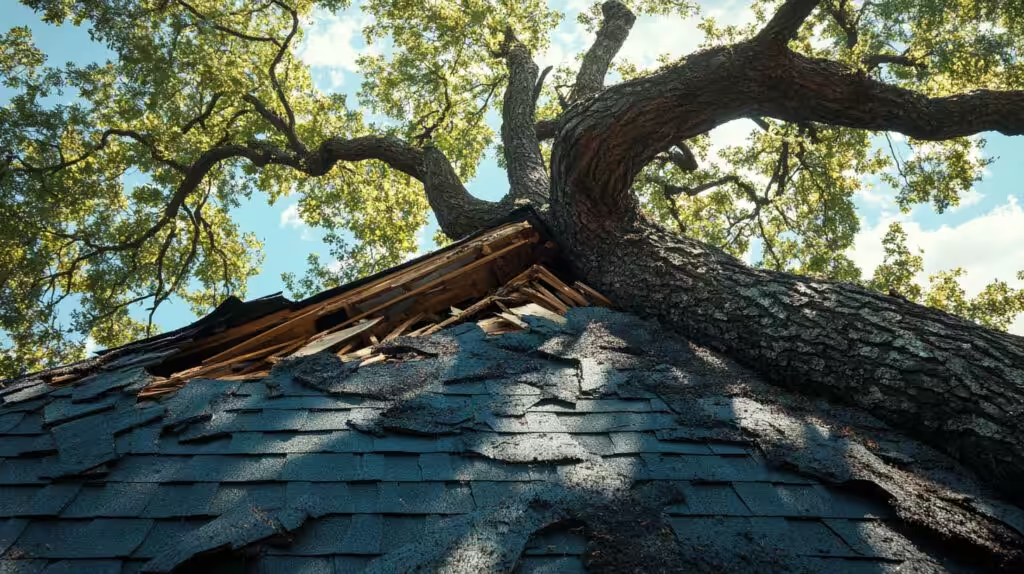
Even smart, careful people make some of the same mistakes every storm season. I see them over and over on jobs in NJ. A lot of headaches can be avoided by knowing what not to do while your nerves are still rattled.
- Mistake 1: Approaching downed lines or DIY cutting near utilities
Problem: Folks underestimate electricity. They climb onto roofs, cut limbs touching wires, or drag branches away from what they think are dead lines.
Fix: Treat every wire as live and deadly. Stay at least 30 feet away. Call 911 plus your utility (JCP&L or PSE&G). Don’t let anyone start cutting until utilities and first responders say the area is safe to work. - Mistake 2: Cleaning up before taking photos
Problem: People start sawing, dragging, and stacking branches to “get it out of the way,” then have very little proof of how bad it really looked for their insurance adjuster.
Fix: Follow fallen tree documentation best practices. Take wide and close-up photos of everything before any debris is moved. Save receipts, reports, and correspondence in one folder or email thread. - Mistake 3: Assuming the neighbor automatically pays
Problem: A lot of NJ homeowners think, “It was their tree, so they owe me,” and then they’re furious when their own insurer is the one handling the loss.
Fix: Understand how NJ storm liability usually works. File with your insurer first. Only chase neighbor liability if you have real evidence of prior notice and negligence, ideally backed by a Licensed Tree Care Operator or written complaints. - Mistake 4: Hiring the first company that knocks on the door
Problem: After a storm, out-of-town “storm-chaser” crews show up, sometimes uninsured, sometimes charging triple local rates, and occasionally leaving mid-job.
Fix: Even in an emergency, stop and verify. Check licensing, insurance, a real NJ business address, and references. Get a written, itemized estimate and ask how they’ll work with your insurance coverage limits. - Mistake 5: Ignoring hidden structural damage
Problem: Someone patches a few shingles and calls it done, but they never check the rafters, wall framing, or attic. Months later, the sag or leak shows up and the claim becomes harder to tie back to the storm.
Fix: Have a qualified contractor inspect roof framing, walls, and, if the hit was hard, any nearby foundation or support points. Hidden damage is easier to get covered right after the event than down the road. - Mistake 6: Not tracking all out-of-pocket costs
Problem: People pay cash for tarps, temp lodging, generator rental, or emergency boarding and never save receipts. Then they’re surprised those costs don’t get reimbursed.
Fix: Keep a simple log with dates, amounts, and what each expense was for. Ask your adjuster which temporary expenses your policy might cover and submit documentation promptly.
Still have questions?
Skip the FAQ — talk to a live NJ Licensed Tree Care Operator in about 5 minutes.
📞 Call (732) 805-0609 24/7 emergency line · No robocalls · Free advice, even if you don't hire usFAQ: Tree Fell on My Property in NJ
If you’re still sorting through what to do after what to do after a tree falls becomes a real-life situation, these NJ-focused answers should clear up the most common questions.
How long do I have to file an insurance claim after a tree falls in NJ?
Most carriers want to hear from you within 24–48 hours of discovering damage, even if the storm is ongoing and crews haven’t reached you yet. The formal claim deadline will be outlined in your policy, but waiting weeks makes it harder to connect the damage to the specific storm and can complicate coverage. Check your declarations page and ask your adjuster directly about any time-sensitive requirements.
How long will it take for the utility company to respond to a downed tree on power lines?
Neither JCP&L nor PSE&G publishes a response time, and neither commits to one. They work by triage: live-wire hazards first, then critical facilities like hospitals, then major feeders, and individual houses after that. On a quiet day that can move quickly; after a widespread storm, when thousands of outages are open at once, the wait can run much longer. Calling 911 and your utility’s outage line is what gets your situation into their system at the right priority — it is the one part of the timing you control. For what our own emergency response covers, see our emergency tree service page.
If my neighbor’s tree falls on my house in NJ, are they responsible?
Usually not. Under standard NJ storm liability rules, your own homeowner’s insurance is your first line of coverage even if the tree grew on your neighbor’s property. Your neighbor’s responsibility only becomes likely if there’s clear proof they knew the tree was hazardous and ignored it, such as prior complaints, Licensed Tree Care Operator reports, or obvious decay they refused to address.
Does homeowner’s insurance in NJ cover tree removal if the tree only falls in my yard?
Often it doesn’t. Many policies limit NJ homeowner insurance tree coverage to trees that damage a covered structure or block your driveway. A tree that falls straight into the grass, garden, or woods with no structure damage is usually considered your maintenance issue, though a few carriers might offer small debris allowances. The only way to know is to read your specific policy or call your agent.
Do I need a permit for emergency tree removal in New Jersey?
In many NJ towns, emergency permit exemptions apply if a tree is an immediate danger or has already fallen and is damaging a structure or blocking access. Municipalities usually let you remove the immediate hazard first, then sort out any paperwork after the fact. Rules for non-emergency removals, protected trees, or certain species can be very different from town to town. For non-emergency removals and permit details, see:
Will FEMA pay for tree removal after a major storm in NJ?
If a FEMA disaster declaration in NJ is issued, FEMA Public Assistance mainly helps municipalities, counties, and certain non-profits clear debris from public roads, parks, and rights-of-way. Private homeowners sometimes get limited individual assistance, but it rarely covers routine tree cleanup in your yard. For most private property damage, especially trees on houses, your primary safety net is still your homeowner’s insurance.
How much does emergency tree removal cost in New Jersey?
Emergency tree removal cost in NJ swings a lot depending on access, risk, size, and timing. As a ballpark, here’s what I usually see:
- Small fallen tree on open lawn, no lines, no structures: roughly $300–$700.
- Medium tree with some structure impact or tricky access: often $700–$1,500.
- Large/complex tree on a roof, near lines, or requiring crane work: commonly $1,500–$3,500+.
- After-hours surcharge for nights, weekends, or holidays: often 10–50% above standard rates.
- Storm season premium during high-demand periods after major storms: prices can climb 10–25% simply because every reputable crew is slammed.
Every site is different. Always ask for written, itemized estimates and make sure the company is insured for this kind of high-risk work.
What should I do if a tree falls on my car in NJ?
If a tree fell on your car in NJ, treat it like any other tree emergency near utilities. Stay away from the vehicle if there are wires on or near it and call 911 if lines are involved. Once the scene is safe, contact your auto insurer. You typically need comprehensive coverage to have storm-related tree damage covered. Take good photos and video before the car is moved, if it’s safe to do so, and save any tow or storage receipts.
How can I reduce the chances of another tree emergency on my property?
The best cure is prevention. Have a Licensed Tree Care Operator inspect trees regularly, especially those near structures and driveways. Keep up with preventive pruning reduces emergencies, structural pruning, and deadwood removal, and don’t be afraid to proactively remove obviously high-risk trees. Thoughtful preventive pruning reduces emergencies and keeps you from living storm to storm wondering which tree will be next.
Final Summary: Handling Fallen Trees Safely and Smartly in NJ
A tree crashing down on your New Jersey property is stressful, but your response doesn’t have to be guesswork. Focus on safety first, keep everyone away from wires, and bring 911 and the utilities into the loop any time power, gas, or blocked roads are part of the picture. Then methodically document the scene, contact your insurer, and figure out exactly what your NJ homeowner insurance tree coverage will and will not handle.
Looking forward, regular Licensed Tree Care Operator inspections, smart pruning, and timely removal of problem trees are the real keys to riding out nor’easters and hurricane remnants without a disaster in the driveway. For more in-depth education on post-storm cleanup, see: . If you live in the Somerville area and want localized guidance, see Somerville emergency tree care.
Keep this guide handy before the next big storm rolls through. With a clear plan, you’ll be able to protect your family, limit damage to your home, and stand on solid ground with your insurance and legal rights under New Jersey law.
Ready to Get That Tree Off Your Property?
Wayne's Tree Service has been the trusted emergency response crew for Central NJ since 1993. If you're dealing with storm damage right now — call. If you want to prevent the next one — call. Either way we'll answer.
🛡 Licensed & Insured ⭐ Since 1993 🕒 24/7 Emergency 📍 Somerset, Hunterdon, Middlesex & Union Counties 📞 Call (732) 805-0609 Request Free Estimate 24/7 Emergency: (732) 805-0609 Mon–Sat: 7am – 6pm regular hours Est. arrival: Same-day for active NJ emergencies