TL;DR: There’s no single statewide tree removal law in New Jersey. Your local town ordinance calls the shots. In most Central NJ and Somerset County towns, you’ll need a permit to remove healthy trees once they hit a certain trunk size (caliper inches), especially if they’re protected or “heritage” trees.
Key Takeaways
- New Jersey does not run tree permits at the state level. Every municipality has its own tree ordinance, with its own thresholds, fees, and exemptions.
- In Somerset County, many towns (Somerville, Bridgewater, Hillsborough, and others) require permits to remove trees above a set caliper inch threshold on private property, even in your own backyard.
- Most permit applications ask for a tree survey or site sketch, species and size, and sometimes an arborist letter from a Licensed Tree Expert or ISA Certified Arborist.
- Commonly protected or “significant” trees in Central NJ include oaks, elms, beeches, maples, and formally designated heritage trees that hit certain diameter benchmarks.
- Typical permit exemptions cover dead or hazardous trees (with documentation), small-diameter trees below the ordinance threshold, certain invasives, and truly urgent emergency storm damage.
- Penalties for unpermitted removal often include fines per caliper inch, mandatory replacement planting, restoration plans, and stop‑work orders on building or renovation projects.
- A Licensed Tree Expert or ISA Certified Arborist is often the difference between a smooth approval and a denial. They document condition, risk, and caliper size to support your permit application.
- For removal costs and land clearing rules, see related resources: and .
What Is an NJ Tree Removal Permit?
An NJ tree removal permit is written permission from your municipality that says you’re allowed to remove, heavily prune, or disturb specific trees on your property. That approval usually comes from a shade tree commission, zoning officer, engineering department, or similar office. Think of it as your town’s way of keeping track of tree loss and making sure important shade trees, especially older oaks and maples, aren’t cut down on a whim. The rules live in your local municipal tree ordinance. There’s no blanket state rule that overrides what your town has adopted.
Do You Need a Permit to Remove a Tree in New Jersey? (Quick Answer)
It all comes down to your municipality. There is no single statewide tree removal permit in New Jersey. Each town writes and enforces its own ordinance. In practice, most Somerset and Hunterdon County towns require permits for trees above a specific caliper threshold on private property. If you’re asking, “Do I need a permit to remove a tree in NJ?”, the honest answer is simple: read your town code or call before anyone fires up a chainsaw. Even with a tree sitting in your own backyard, plenty of Central NJ towns regulate:
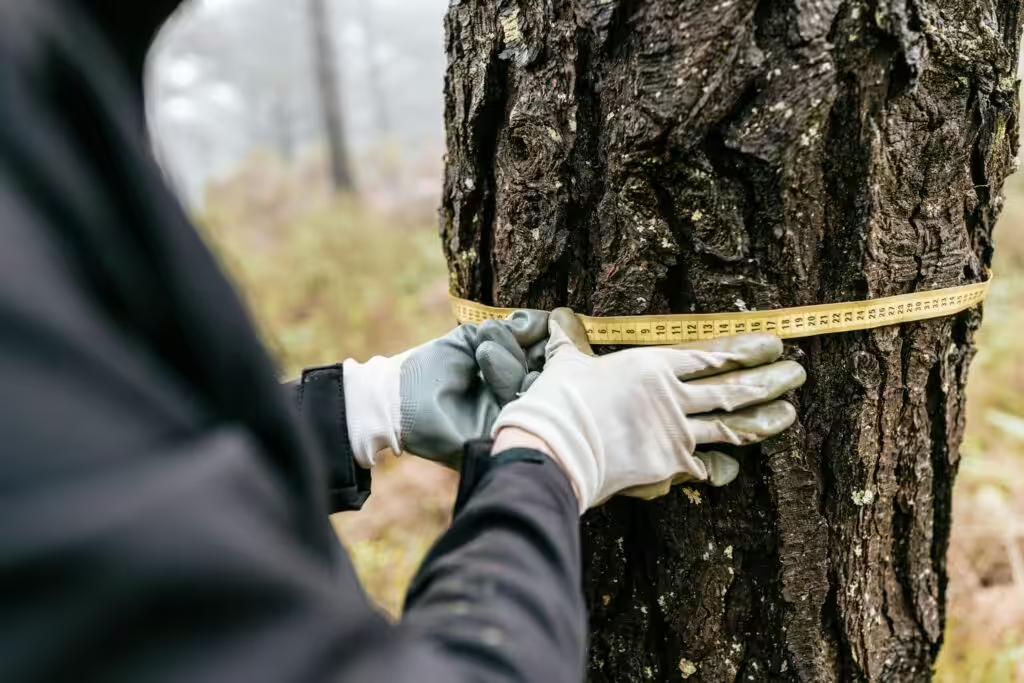
- Tree removal above a specific trunk diameter (caliper inches), measured at standard DBH height
- Removal of protected species like oaks, elms, or designated heritage trees
- Trees growing within certain setbacks, easements, drainage areas, or right‑of‑way strips
- Groups of removals linked to construction, additions, grading, or land disturbance
I see a lot of folks rely on “my neighbor didn’t need a permit” and end up in trouble. Ordinances change, inspectors change, and sometimes the neighbor was just lucky enough not to get caught. Don’t gamble on that. Here’s what you should actually do:
- Call your municipal clerk or engineering/zoning office and tell them you’re planning tree removal.
- Ask specifically for the tree preservation ordinance or tree removal permit section of your code.
- Request any forms, checklists, and fee schedules that apply to residential tree removal.
For more on service logistics, safety, and what a removal project looks like from the work side (not the permits), see: .
How NJ Tree Ordinances Work (Town-by-Town Rules)
New Jersey runs tree rules locally. Each town adopts its own tree preservation ordinances, usually with input from a shade tree commission or environmental commission. Those ordinances are often written so the town qualifies for state programs like the NJ Community Forestry Program and guidance from the NJ Shade Tree Federation. Even though the fine print changes from one municipality to the next, they tend to cover the same main topics:
- Caliper inch thresholds that trigger permits, like “any tree ≥ 6" DBH” or “all trees above 8" DBH except invasives”
- Definitions of protected, significant, or heritage trees, including size and species criteria
- Replacement requirements, often written as a canopy replacement ratio such as one new tree for every 4 inches of DBH removed
- Application fees, review timelines, and inspection processes
- Penalties for unpermitted removal, typically fines per inch, required plantings, or payment into a tree fund
Many of these ordinances track NJ DEP’s community forestry guidance. To stay eligible for NJ DEP community forestry funding, towns are expected to maintain a community forestry plan and appoint a shade tree commission or similar oversight board.
Somerville Borough Tree Ordinance (Somerset County)
The Somerville tree ordinance is aimed at keeping Somerville’s older shade trees and established canopy intact, especially when properties are developed or heavily altered. If you’re cutting just one tree for safety, the rules are usually simpler. Once you start mixing in construction, grading, or multiple removals, the ordinance matters a lot more. Key components you’re likely to see in Somerville’s code include:
- Caliper threshold: Permits are often required once trees reach a certain size, commonly in the 6–8″ DBH range for non‑street trees, and sometimes lower thresholds for public or street trees under Borough jurisdiction.
- Protected species: Native shade trees like Red and White Oaks, maples, American Elm, American Beech, plus any trees formally identified as heritage trees or significant trees because of size, age, or history.
- Application fee: A standard residential fee per application, typically below major building permit fees, with higher fees for subdivisions, commercial sites, or extensive site work.
- Somerville shade tree commission: A Borough-appointed body that oversees public trees and can weigh in on private tree removal connected to development or site plans.
- Penalty structure: A system of penalties per inch of unpermitted removal, which may be a per‑caliper‑inch fine, mandatory replacement planting at specific sizes, or contributions to a tree fund.
In practice, if you’re planning an addition, a new driveway, or a major landscape overhaul in town, talk with someone who knows tree care in Somerville and how the ordinance is enforced. That’s often the difference between a quick sign‑off and getting dragged into a longer review.
Bridgewater Township Tree Permit Rules
Bridgewater Township runs one of the more detailed tree preservation systems in Somerset County. The rules really kick in for development projects, larger lots, and anything tied to engineering plans. Here’s what usually comes into play in Bridgewater:
- Caliper threshold: Trees above a set diameter, often in the 6–8″ DBH or larger range, fall under the permit rules, especially if a building, grading, or drainage plan is involved.
- Environmental commission review: Many Bridgewater applications are routed to an environmental commission review or interdepartmental review when site plans, subdivisions, or sensitive areas are involved.
- Replacement requirement: A defined replacement ratio, such as 1 new tree for each 4–6 inches of diameter removed, or a canopy-based formula. If there’s nowhere to replant on site, the township may allow a fee-in-lieu.
- Exemptions: The ordinance usually exempts dead trees (with proof), confirmed hazard trees, and certain invasive species listed by NJ DEP, though there may still be basic notification or documentation expectations.
- Application method: Bridgewater has been shifting toward online application portals for tree permits, though some larger or more technical submissions still go in through the engineering or planning office with paper backup.
For projects involving multiple removals, especially near wetlands, floodplains, or steep slopes, expect to provide a tree survey site plan that shows each tree’s size, species, and exact location. That’s often prepared by an engineer or surveyor with input from an arborist.
Hillsborough Township Shade Tree Commission
Hillsborough Township leans heavily on its shade tree commission for tree-related decisions. That commission supports the Township’s community forestry plan under the NJ Community Forestry Program and keeps an eye on the long-term health of street and park trees. Typical ordinance points in Hillsborough include:
- Permit requirements once trees reach a certain caliper size, both on residential and commercial properties, especially when removals exceed a small, defined number per year.
- Regular oversight by the Hillsborough Township shade tree commission for public-right-of-way trees and, in some situations, for private trees tied to site plans, major grading, or subdivision projects.
- Monthly meetings where the commission reviews permit applications, planting proposals, and, occasionally, appeals or complaints.
- A structured appeal process if your tree permit is denied or if you disagree with conditions like required replacement plantings.
- A requirement that Hillsborough maintain an up‑to‑date community forestry plan to remain eligible for state forestry grants, training, and technical assistance.
Most homeowners start with the engineering or planning office, but for tricky situations like suspected heritage trees or major canopy removal, the commission’s opinion can shape the final decision.
Other Somerset County Towns & Central NJ Municipalities
Other Somerset County municipalities and surrounding Central NJ towns have similar setups, but the numbers and definitions shift. Somerset County shade tree commissions in places like Bernards and Montgomery, for instance, follow the same general logic with their own twist on the rules. Across Central NJ, you’ll run into differences like:
- Varying caliper thresholds for what counts as a regulated tree. Some start at 4″ DBH, others at 6″, 8″, or even 10″.
- Local programs for significant tree designation or heritage tree NJ, where individual trees can be protected based on their size, age, or cultural importance, regardless of species.
- Tree preservation ordinances tied to stormwater controls, shade goals, and neighborhood character, often linked to bigger planning and zoning objectives.
- Additional paperwork, such as a township zoning permit, when tree removal is part of new construction, a new driveway, or a major renovation.
Because there is no “standard” NJ ordinance, you should always look up the rules for your exact town and block/lot. Guessing wrong can get expensive fast.
NJ Tree Removal Permit Application Process (Step-by-Step)
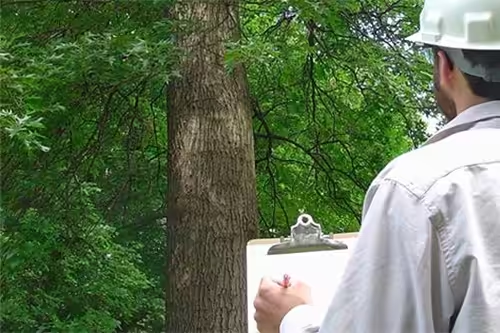
Most towns in New Jersey handle tree permits in roughly the same order, even if the forms look different. If you understand the basic workflow, you’ll be ahead of most first‑time applicants trying to remove a big oak or maple. 40‑word overview: Talk to your town’s clerk or shade tree officer, get the correct tree removal permit form, measure and document each tree, attach photos and any required arborist letter, pay the permit fee, wait for review, then follow all conditions on the approval.
Typical Step-by-Step Process
- Confirm whether a permit is required. Call your municipal clerk, planning, or engineering department, or search your town’s website for the NJ tree ordinance that applies at your address. Ask which office handles tree permits, what trees are regulated, and what caliper threshold triggers a permit.
- Obtain the correct application form. Download the form from the town’s website or pick it up at the municipal building. It may be labeled “tree removal permit,” “tree protection permit,” or included as part of a broader township zoning permit packet for construction projects.
- Document the tree(s). Measure trunk diameter at 4.5 feet above the ground, which is the standard DBH measurement. Identify the species as best you can, then note how close each tree is to your house, property line, overhead wires, sheds, or septic. Take several clear photos from different angles showing both the tree and your structures.
- Prepare a simple tree survey site plan. For a small job, you can often draw a scale sketch of your lot showing the house, driveway, and each tree you want to remove. Mark each tree with a number that matches your application list. For larger projects or anything tied to grading or drainage, your town may require a professional survey or engineer’s plan to serve as the tree survey site plan.
- Obtain an arborist letter, if required. Some municipalities won’t accept your word that a tree is dead or dangerous. They want a letter or report from a Licensed Tree Expert or ISA Certified Arborist. This is especially true if you’re claiming a permit exemption dead tree or hazard tree exemption. The arborist will document decay, lean, root issues, or structural cracks.
- Submit the application and pay the fee. Turn in your application, supporting documents, photos, and payment to the right office. Some towns now accept online submissions, including uploads of photos and site plans. Others still expect hard copies or mailed packets.
- Wait for review and site inspection. A shade tree commission member, inspector, or zoning officer may visit your property to verify measurements, confirm the tree’s condition, and check whether it might be a heritage tree or part of a protected stand. They may also look for conflicts with utilities, sidewalks, or nearby wetlands.
- Receive approval, conditions, or denial. If approved, the permit often comes with conditions. Common ones include a replacement tree requirement, restrictions on stump removal near utilities, or timing limitations to avoid nesting seasons. If it’s denied, you should be pointed to the ordinance section explaining your appeal process.
- Schedule removal with a properly licensed company. Hire a contractor that understands licensed tree removal in Central NJ. Confirm they hold the required NJ LTCO license for tree work, carry current insurance, and know how to protect nearby trees you’re not removing.
- Request final sign-off (if required). For bigger projects or development sites, the town may come back after removal to verify work and any required replanting. Only after that final inspection is your permit fully closed out in their system.
Required Documents
Towns all have their own checklists, but the same core documents pop up everywhere. Plan on gathering at least the following before you apply:
- Completed tree permit application form signed by the property owner or an authorized agent
- Property address and block/lot information, which you can usually find on your tax bill or GIS map
- Tree information for each tree:
- Species, like Red Oak, White Oak, American Beech, or Sugar Maple
- Caliper / DBH measurement in inches at 4.5 feet above grade
- Reason for removal, such as dead, dying, hazardous, construction, interference with utilities, or nuisance
- Tree survey site plan or basic sketch including:
- Property boundaries, house footprint, and any detached structures
- Numbered locations of each proposed tree removal
- Driveways, sidewalks, known underground utilities, and easements
- Photos clearly showing each tree, the base, the canopy, and proximity to nearby structures or lines
- Arborist letter requirement documents, if applicable:
- Formal assessment of tree health and structural integrity
- Written statement supporting a dead tree or hazard tree exemption claim
- Professional recommendations on whether removal is necessary or if pruning/cabling would address the issue
- Owner authorization if the applicant is a contractor, HOA, or property manager acting on behalf of the owner
Note that permit fees add to cost beyond the base removal price.
Fee Schedule: Typical Tree Removal Permit Cost in NJ
Tree removal permit cost NJ changes from town to town, and it can also change when ordinances are updated. As of roughly 2024–2025, many Central NJ municipalities fall into these common ranges for permits themselves (not the removal work):
- Residential single-tree permit: usually between $0 and $75 per application, sometimes waived for simple dead-tree cases.
- Multiple trees / construction-related: often $50–$250+, and sometimes the fee climbs as you add trees or total caliper inches.
- Replacement planting fees-in-lieu: if you can’t plant required replacement trees on site, many towns charge roughly $100–$400 per required replacement tree into a municipal tree fund.
Those fees are only one part of your overall project budget. For a deeper breakdown of how permit costs fit into total removal pricing, equipment, and disposal, see:
Processing Timeline
The time it takes to get an NJ municipal tree permit approved often matters more than the fee. If you’re trying to line up tree work with a foundation pour or a roofing crew, delays can get expensive.
- Simple residential removal: usually around 1–2 weeks, as long as your paperwork is complete and no one flags the tree as protected or controversial.
- Complex or construction-linked removal: often 3–6 weeks, especially if a shade tree commission or environmental commission review fits into a monthly meeting schedule.
- Emergency approvals: many towns allow immediate removal of truly hazardous trees, provided you submit 48‑hour documentation afterward and, in some cases, a follow‑up permit.
If your tree removal ties into a building permit, apply early and treat the tree permit as a critical path item. I’ve seen plenty of projects frozen mid‑construction because someone assumed an old maple “wouldn’t be an issue.”
Protected Tree Species in Central NJ
In Somerset County and nearby towns, ordinances often give extra protection to large native shade trees like oaks, elms, beeches, and maples, plus formally designated heritage trees. Once they cross certain caliper sizes, you’ll usually need permits, replacement planting, or both to remove them. Each municipality defines “protected tree” in its own way, but across Central NJ, these buckets show up repeatedly:
- Native shade trees above a set caliper threshold, usually measured as DBH
- Heritage trees NJ that are recognized for age, trunk size, or local historical value
- Trees growing in public rights-of-way or within mapped shade tree zones
- Trees preserved under site plan approvals, easements, or past mitigation agreements
Some of the most common protected or significant species you’ll see in Central NJ ordinances include:
- White Oak (Quercus alba) – Long-lived and often massive, with deep roots that help stabilize soil.
- Red Oak (Quercus rubra) – New Jersey’s state tree, often prioritized in replacement plans and protection lists.
- American Beech (Fagus grandifolia) – Recognized for smooth gray bark and dense shade, often protected as a mature specimen.
- American Elm (Ulmus americana) – Now relatively rare due to Dutch elm disease, so surviving specimens tend to be treated carefully.
- Sugar Maple (Acer saccharum) – A strong shade tree that shows up as both a protected species and a recommended replacement tree in many ordinances.
In many codes, any of these trees above a set diameter, such as 8″ or 10″ DBH, qualify as significant. Truly massive trees, often above 24″ DBH, may be singled out as heritage trees. Removal of those usually requires clear evidence that they’re dead, severely diseased, or undeniably hazardous. On top of individual trees, some ordinances also protect:
- Groves or stands of native trees, especially where cutting several at once would wipe out most of the existing canopy on a lot
- Trees along stream corridors, in riparian buffers, wetlands, or steep slopes to reduce erosion and flooding
- Trees that were already planted or preserved to satisfy older landscaping or mitigation plans, which often can’t be removed without replacement
In practice, if you’re thinking about removing a mature oak, elm, beech, or maple in Central NJ, treat it as if it might be protected. Call the town, give them the trunk diameter, and ask how it’s classified before you schedule work.
Permit Exemptions: When You Don’t Need a Permit in NJ
40‑word overview: Most New Jersey towns carve out clear permit exemptions, including emergency permit exemptions after storms. Those usually cover dead trees, hazard trees, smaller-diameter trees below the minimum size, listed invasive species, and emergency storm damage. Many of those exemptions still require photos, an arborist letter, or quick after‑the‑fact notification. Permit exemption criteria NJ focus less on “never” and more on “under these exact conditions.” Here are the categories you’ll see in a lot of local codes:
- Dead tree exemption – If a tree is clearly dead and not tagged as historically important, many towns won’t make you jump through the full permit process. However:
- Some ordinances require a Licensed Tree Expert or arborist letter confirming that the tree was dead at the time of removal.
- Others ask for photos and a short written statement within a certain timeframe after the work is done.
- Hazard tree exemption – Trees that pose immediate danger, like a cracked trunk over a house or a root system lifting out of the ground, are often exempt if:
- You can provide solid hazard documentation, including photos of splits, root heaving, or storm damage.
- An arborist, code official, or inspector confirms in writing that the tree was an imminent risk.
- Invasive species exemption – Many ordinances openly encourage removal of invasive trees listed by the NJ DEP or similar agencies, such as Tree-of-heaven or Norway maple. As a result, these trees may be:
- Exempt from permits below certain sizes, or
- Subject to a shorter, simplified review with limited or no replacement requirements.
- Minimum caliper exempt – Small trees don’t usually trigger permits. Most towns exempt trees under a specific size, often under 4″–6″ DBH. That number is different town to town, so you still need to check.
- Emergency storm damage – After heavy storms, inspectors know you can’t leave a half‑broken tree over your roof just because the office is closed. Many codes allow immediate removal of uprooted or fractured trees that pose risk, with:
- A requirement to submit 48‑hour documentation, including photos, a brief description, and sometimes a retroactive form.
- Occasional follow-up inspections to confirm that the emergency work matched your explanation.
Even if you’re exempt from a tree permit, you still have to follow any HOA rules, local safety standards, and utility easement restrictions. For severe hazards or storm blowdowns, hiring emergency tree removal pros who understand both the physical risk and the paperwork can keep you out of trouble later.
Penalties for Removing a Tree Without a Permit in NJ
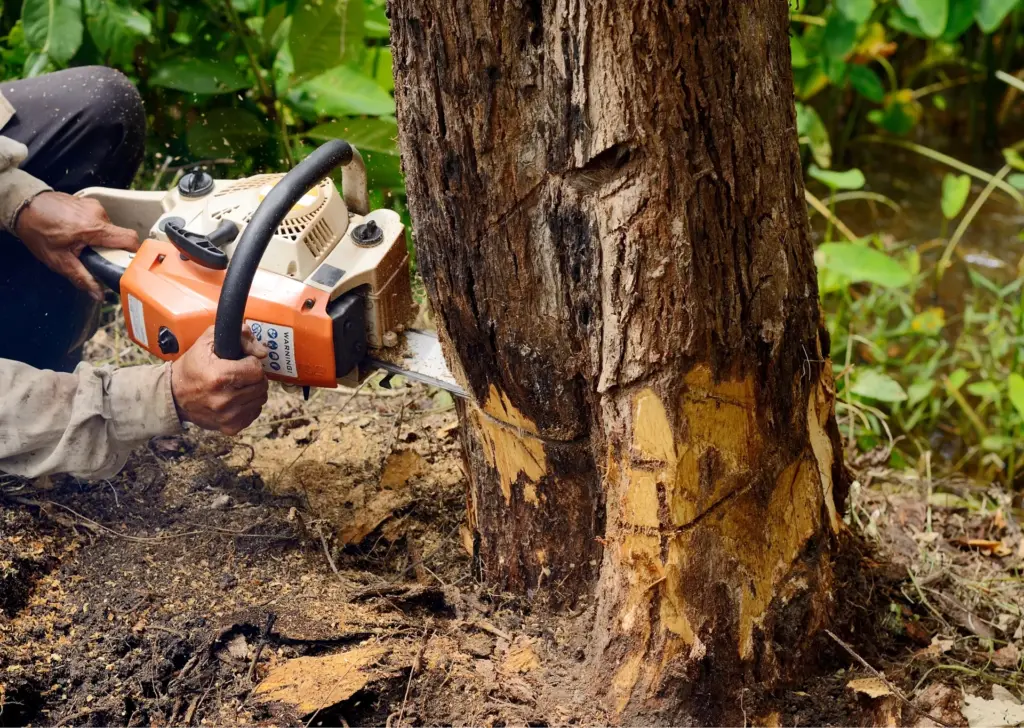
Skipping the permit can get very expensive. New Jersey municipalities often fine based on caliper inches removed, require multiple replacement trees, charge restitution into tree funds, add court costs, and even put stop‑work orders on construction until violations are fixed. Each local ordinance has its own version of a penalty unpermitted removal section. In Somerset County and similar Central NJ towns, common consequences include:
- Fines per caliper inch removed – You might see language like “X dollars per inch of DBH” for each tree removed without approval, which adds up quickly on large oaks or maples.
- Mandatory replacement tree planting – Replacement is typically based on a canopy replacement ratio, such as:
- 1 new 2.5″ caliper tree for every 6″ of DBH removed, or
- Several smaller trees designed to match or exceed the lost canopy over time.
- Restitution payments – If you don’t have room to replant enough trees on site, towns often require a per‑tree or per‑inch payment into a municipal tree fund so they can plant elsewhere.
- Court costs and enforcement fees – If an inspector writes a summons and your case goes to municipal court, you may be responsible for court costs, re‑inspection fees, or administrative charges.
- Stop-work orders – If the unlawful removal is tied to a building project, the town can halt all related work until the violation is resolved, which can delay contractors and drive up costs.
- Denial or delay of future permits – Repeat offenders or major violations can make zoning and building departments much tougher on your future applications.
Penalty ranges that often appear in Somerset County codes include:
- Per‑inch fines: Often somewhere in the $10–$50 per caliper inch range, sometimes higher for protected species or heritage trees.
- Flat per-tree fines: Sometimes $250–$1,500 per tree, especially if the tree was protected, very large, or in a sensitive area.
By the time you add replacement trees, restitution, and possible court costs, trying to “save time” by skipping the permit rarely works out cheaper. Spending a bit of effort up front usually costs far less than fixing a violation later.
If you don’t have one yet, here’s how to find a licensed service for permit letters before you submit your application.
What a Licensed NJ Tree Expert Does for Permit Applications
40‑word overview: A Licensed Tree Expert is your technical backup. They measure caliper size accurately, confirm species, document defects, and write arborist letters that towns rely on. That expert opinion often decides whether a tree qualifies as dead, hazardous, or appropriate for removal. New Jersey regulates tree work under the NJ Board of Tree Experts, which issues licenses for Licensed Tree Experts (LTEs) and Licensed Tree Care Operators (LTCOs). Municipal staff, shade tree commissions, and insurance companies know these credentials and often trust their written evaluations, especially when paired with ISA certifications. In the context of permits, a Licensed Tree Expert can step in to:
- Assess the tree – Check for decay, cracked stems, root issues, weak branch unions, and overall health. They’ll look at how likely the tree is to fail and what it might hit.
- Confirm species and caliper size – Measure trunk diameter correctly at 4.5 feet, note multi‑stem situations, and document whether the species is considered protected, native, or invasive.
- Prepare an arborist letter – Draft clear, detailed reports that many towns require for:
- Dead tree exemptions
- Hazard tree exemptions
- Requests to remove a heritage or significant tree that would otherwise be preserved
- Suggest alternatives – Recommend pruning, cabling, bracing, soil work, or root-zone protection if a tree can safely be saved and you’d rather not remove it.
- Advise on replacement species – Help pick new trees that satisfy your town’s replacement tree requirement, fit your yard, and avoid common long‑term issues like weak wood or invasive roots.
In practice, working with a qualified expert makes your application more professional and complete. That cuts down on back‑and‑forth with the town and reduces disputes with neighbors, HOAs, or inspectors who might question why a big, prominent tree was removed.
Entity & Attribute Snapshot (EAV Table)
This table pulls together the key entities and attributes you’re likely to see in NJ tree permit discussions. Treat these as typical ranges and patterns, not guarantees. Local ordinances and fee schedules change, so always verify with your own municipality.
| Entity | Attribute | Typical Value / Explanation |
|---|---|---|
| NJ municipal tree permit | Caliper threshold | Often 4–8 inches DBH for regulated trees. Each municipality sets its own number and may have separate thresholds for different zones. |
| NJ municipal tree permit | Application fee | Approx. $0–$75 for basic residential permits, with higher fees for multi-tree or development-related projects. |
| NJ municipal tree permit | Arborist letter requirement | Common for dead/hazard tree claims and heritage trees. Often waived for small, straightforward removals. |
| NJ municipal tree permit | Processing time | Typically 1–2 weeks for simple applications and 3–6 weeks if commission or board review is required. |
| NJ municipal tree permit | Replacement ratio | Frequently written as 1 new tree per 4–6 inches of DBH removed, or a similar canopy-based formula. |
| Somerville tree ordinance | Caliper threshold | Often around 6–8 inches DBH for regulated private trees, though exact numbers should be confirmed in the current code. |
| Somerville tree ordinance | Protected species | Focus on native shade trees such as oaks, maples, elms, beeches, plus any specifically designated heritage trees. |
| Somerville tree ordinance | Fee per application | A flat residential fee, generally under $100, with higher tiers for subdivision or development work. |
| Somerville tree ordinance | Shade tree commission | Yes. A municipal commission oversees public trees and participates in review of some regulated trees. |
| Somerville tree ordinance | Penalty per inch unpermitted | Fine calculated per caliper inch of tree removed without a permit, with specific rates in the municipal code. |
| Bridgewater Township tree permit | Caliper threshold | Typically 6–8 inches DBH or larger. Often different standards for street trees versus private-yard trees. |
| Bridgewater Township tree permit | Environmental commission review | Yes for many site plans, subdivisions, and large removal projects that affect overall site design. |
| Bridgewater Township tree permit | Replacement requirement | Uses a defined canopy replacement ratio or a set number and size of new trees based on removals. |
| Bridgewater Township tree permit | Exemptions | Dead trees, hazard trees, and listed invasive species, with exact language detailed in the township code. |
| Bridgewater Township tree permit | Application method | Online portal available for many permits, with some projects still filed in person through engineering or planning. |
| NJ shade tree commission | Authority | Appointed by the municipality, with advisory and sometimes regulatory authority over shade trees. |
| NJ shade tree commission | Scope | Typically focuses on public trees and rights-of-way but may review private trees through municipal ordinances. |
| NJ shade tree commission | Meeting frequency | Often meets monthly, with agendas covering permits, plantings, removals, and policy updates. |
| NJ shade tree commission | Appeal process | Yes. Many ordinances provide a process to appeal permit denials or imposed conditions. |
| NJ shade tree commission | Community forestry plan | Required to remain eligible for NJ Community Forestry Program grants and technical support. |
| Permit exemption criteria NJ | Dead tree | Often exempt if supported by an arborist letter, photos, or similar proof submitted to the municipality. |
| Permit exemption criteria NJ | Hazard tree | Usually exempt when an imminent risk is documented by photos or a professional assessment. |
| Permit exemption criteria NJ | Invasive species | Species on the NJ DEP list often qualify for streamlined permits or full exemptions. |
| Permit exemption criteria NJ | Minimum caliper exempt | Commonly trees under 4–6 inches DBH, with the exact minimum listed in each local ordinance. |
| Permit exemption criteria NJ | Emergency storm | Immediate removal allowed in many towns, followed by a 48‑hour documentation submission requirement. |
Common Mistakes NJ Homeowners Make (and How to Avoid Them)
- Assuming no permit is needed because the tree is on private property. Fix: Don’t assume “my yard, my rules.” Many towns regulate private trees once they hit certain sizes. Call or check the ordinance before cutting, even if the tree sits squarely inside your fence line.
- Relying on verbal assurances instead of written approval. Fix: A quick “you’re probably fine” over the phone is not protection. Wait until you have a written permit or an email/letter confirming an exemption before scheduling removal.
- Mis-measuring caliper size. Fix: Measure at 4.5 feet above ground (standard DBH). On slopes, measure from the uphill side. If you’re even a little unsure, have a Licensed Tree Expert double‑check it so you don’t accidentally fall over the threshold.
- Ignoring replacement tree obligations. Fix: Read every permit condition. You might be required to plant specific species, minimum caliper sizes, and exact locations by a certain date, then provide proof of planting to close the permit.
- Skipping documentation for dead or hazard trees. Fix: Before the crew cuts, take clear photos and keep any arborist letters. After the job, keep receipts and submit any required post‑removal forms, especially for emergency exemptions.
- Confusing HOA rules with municipal ordinances. Fix: Treat them as two separate layers of approval. Your HOA’s blessing doesn’t replace a municipal permit, and municipal approval doesn’t guarantee HOA sign‑off. You need both where they apply.
FAQ: NJ Tree Removal Permits
How much does a tree removal permit cost in NJ?
A: In many Central NJ towns, a straightforward residential tree removal permit lands between $0 and $75. Once you add multiple trees or connect the work to construction, the fee can climb. Some municipalities also charge separate replacement planting costs if on‑site replanting isn’t possible. Always check your current local fee schedule before you apply.
How long does it take to get a tree permit approved?
A: For a single, non‑controversial tree, you’re usually looking at 1–2 weeks from a complete submission. If your application has to go in front of a shade tree commission or environmental commission, figure on 3–6 weeks, since those groups tend to meet monthly. In storm emergencies, towns often allow immediate work with retroactive documentation.
What if my neighbor’s tree is dangerous and they won’t act?
A: Your municipal tree permit typically covers what you do on your own property. Disputes about a neighbor’s tree are mostly civil issues. That said, an arborist letter documenting the hazard can help if you need to put your neighbor on notice or build a case. For serious situations, talk with your town’s code office or an attorney who handles property disputes.
Does my HOA approval replace a municipal tree permit?
A: No. HOA rules and municipal ordinances are separate. You can’t use HOA approval as a substitute for a town permit. You need to satisfy both sets of rules. Your HOA may block a removal the town would allow, and the town can require a permit even if the HOA signs off immediately.
Do I need a permit to remove a dead tree in NJ?
A: Many municipalities exempt clearly dead trees from the full permit process, but some still ask for proof, such as photos or an arborist letter. Others require a no‑fee permit or a simple notification. Don’t rely on assumptions. Read your town’s permit exemption dead tree language or call the office and ask.
What counts as an emergency tree removal?
A: Emergency tree removals usually involve trees that are uprooted, split, or obviously about to fail on homes, driveways, roads, or power lines, especially after storms. Most towns allow immediate action so you can stay safe, but they expect 48‑hour documentation, photos, and sometimes an after‑the‑fact permit or letter to close out the file.
What happens if I remove a tree without a permit?
A: You open yourself up to fines per caliper inch, required replacement planting, possible restitution into a tree fund, court costs, and even stop‑work orders if a building project is involved. On large trees, those penalties can easily exceed what you would’ve spent on doing it by the book.
Are stump grinding and cleanup covered by the permit?
A: Most ordinances focus on the tree trunk and canopy, not the stump itself. That said, your permit may have conditions about grading, root removal near property lines, or soil disturbance. For what happens after the tree hits the ground and gets chipped, including stump grinding after removal and site restoration, see:
Can I include multiple trees on one permit application?
A: In many towns, yes. You can list several trees on a single form as long as they’re on the same property and removed as part of one project. Some municipalities charge extra for each additional tree or for total caliper inches, so check the fee schedule and plan accordingly.
Who oversees municipal tree rules in New Jersey?
A: Locally, shade tree commissions, zoning boards, engineering departments, or code offices enforce municipal tree ordinances. On the state side, organizations like the NJ Shade Tree Federation, NJ Community Forestry Program, and the NJ Board of Tree Experts help set standards, offer training, and support local programs.
Working with a licensed tree removal in Central NJ crew that knows your local ordinance is the smoothest way to stay compliant.
Final Summary & Next Steps
NJ tree removal permits feel confusing mostly because there’s no single statewide rule. Every municipality uses its own tree preservation ordinance, its own thresholds, and its own list of exemptions. If you take a few simple steps up front, the process is usually manageable.
- Check your town’s ordinance or call the municipal office to confirm if a permit is required for your specific trees.
- Carefully document species, size, and condition, and involve a Licensed Tree Expert whenever you’re dealing with large, borderline, or potentially protected trees.
- Apply early, follow replacement tree requirements exactly, and keep written copies of permits, letters, and photos in case questions come up later.
If you’re ready to move from background research to actual work, here’s a straightforward way to start:
- Contact your municipal office and request the current tree permit form, checklist, and fee schedule.
- Gather measurements, clear photos, a simple sketch of your property, and any HOA approvals you may need.
- Schedule a visit with a qualified tree professional who understands your town’s process, can prepare an arborist letter if needed, and can complete the removal safely and legally.
For detailed information on overall project cost and how permits fit into full removal pricing, read: . For larger site work, multiple removals, or tree permits during land clearing projects, see: .